ニューヨークの生活はとても面白い。お金があったら毎日好いレストランで食事をしたり映画館と音楽会へ行ったりすれる。お金があらないたら綺麗な公園を散歩したり有名な美術館で絵を見たりすれる。それから全世界の国の人はニューヨークにあるからほかにところへ行く理由があらない!
Tuesday, September 29, 2009
ニューヨークと私
「どんな国の人ですか」は 私によく聞きた問題だ。中国人だ?アメリカ人だ?自分のアイデンティティーにどやってと思う?中国から来たけどあそこで住まないかった。そしてアメリカで住んでいるんだがニューヨークは二十二年の家だ。それから私はアメリカ人と中国人だ前に 先ず ニューヨーク人だ!
ニューヨークの生活はとても面白い。お金があったら毎日好いレストランで食事をしたり映画館と音楽会へ行ったりすれる。お金があらないたら綺麗な公園を散歩したり有名な美術館で絵を見たりすれる。それから全世界の国の人はニューヨークにあるからほかにところへ行く理由があらない!
ニューヨークの生活はとても面白い。お金があったら毎日好いレストランで食事をしたり映画館と音楽会へ行ったりすれる。お金があらないたら綺麗な公園を散歩したり有名な美術館で絵を見たりすれる。それから全世界の国の人はニューヨークにあるからほかにところへ行く理由があらない!

Tuesday, September 15, 2009
わたし
新しい学期が始めたからもう一度紹介しよう。私の名前はスーシャン・ワンだ。中国語のなまえた。漢字で王思翔だ。王思翔の英語の読み方は英語の六と同じだからアメリカの友達はSixで呼ぶ。それから私のブログは六郎日記だ。
中国で生まれてから三歳からニューヨークで住んでいる。大学はコロンビア大学だた。大学で卒業てから二年働いた。それからも一度コロンビア大学へいった。今コロンビア大学院のアジア歴史を勉強する二年生だ。韓国の古代歴史を研究している。中国の外交と文学も研究している。
Sunday, May 31, 2009
What is My Construction...
I had started this piece with the intention of finishing, but as it were, I think it no longer quite appropriate.
One can have a moral view, an understanding of right and wrong, but once it is declared, expounded, and preached, hypocrisy is inevitable.
I am not a moral philosopher.
Saturday, May 9, 2009
What is my Construction? Part 1: Introduction
"This Culture of Ours":-- the Chinese intellectual tradition, civil society in America, Columbia's core curriculum and my life?
I have been asked here and there questions to the effect of, "are you religious?" "what do you believe in?" "do you think they are more Chinese or more American?" I could never responsibily answer any of these questions, mainly because the expectation is a short one word answer, but invariably, whatever one word answer I give would misconstrue what it is I am trying to represent. In our discourse, in the way we answer these things, religion is a set of prescribed doctrines in accordance with an established ecclesiastical organization; what one believes is a semi-coherent -ism, an ideology of life and world that identifies the fundamental values of our being; and whether one is of one country, of one nationality, of one ethnicity prescribes a set of cultural values and practices, dictated by anything from some vague idea of tradition coupled with the manner with which one eats food. None of these categories do justice to the variety and complexity with which inviduals constructs their interiorities and certainly the ways in which they situate themselves in the world-- or even, how they construct the world around them.
Construction and the Post-Modern Confucian
Construction is a decidedly post-modern concept and one that is useful for the exercise of understanding the big questions of culture, identity and world-view. Construction is the process by which an individual psyche interacts, organizes and interprets the phenomenonlogy of experience, it is the way of fixing an ontology amdist the interplay of sense expreience, moral value and emotional reactivity. Construction is the process of narrative, the process of situating, the process of interpreting, the process of understanding--- construction by definition constructs constructs, but that these constructs are constructed, and by defintion can be deconstructed, do not detract from their "realness."
What is your construction? It is perhaps that question that I will be more willing to answer over the three that I mentioned before. But even so, I woudl find it difficult to do so and doubly reluctant to address it. After all, my own construction is but one in many-- what vaunted vanity must it take to undergo such an exercise? Furthermore, constructions shift, constructions change, constructions are deconstructed and reconstructed-- a building built will slowly be replaced, one wall, one floor, one pipe at at time-- is it still the same building? To answer it aloud, to put it in writing, is to grant this construction that only exists in a specific moment in space-time an after-life that outlasts itself. In writing, I am fixing the terms by which this construction, this identity will be understood. That sort of fixity is threatening-- thirty years from now, when I re-read this, I will inevitably feel the tyranny of the past, an imposition of truth, an imposition of vision from an age that is no longer relevant, yet irrevocably eternal. As written, the Word is unchangeable; as written, this version, this expression forces posterity, whether it is the posterity of man's future or one's personal future, to cast its own formulations in the terms of the past. It is for this reason that the Chinese (or more specifically and generally, all those who had a stake in this siwen) were so concerned with the power and legacy of their own writing.
I spoke of writing as an exercise in self-construction, and I projected myself in thirty years pestered by the tyranny of my own thoughts in the present. This is also the tyranny of tradition. The tyranny of the past. Once conscious, once aware, once one reads or recites and resusciates it, it must be dealt with. It must be deferred, discussed, rejected, thought about and written about--- and by that process it is transmitted. The irony of tradition is, the harder one tries to break away from it, the stronger in looms before you.
What is my construction? My construction is decidedly Chinese, it is very Confucian, but it is very Buddhist, but it is one that could not exist without having drawn from the product of my own intellecutal tempering in the most self-consciously Western institutions in "the West." The puzzle is complex, and it is one that I do not undrestand completely, nor is it one, I think, that I neccessarily should. One's true motivations remain hidden from view, but who knows what purpose I hope to gain from writing this-- do I indeed wnat to fix myself vis-a-vis the past, in terms of the future?
What is my construction? I'll start with Confucianism. One can pick up any book from the library or the bookstore and read about what Confucianism is. Confucianism is a lot of things. It's misogynistic, traditional, pedantic, oppressive and really old. But it's also a construct. It is something that exists not as a coherent object the sum, average, mean and aggregate of a whole web of constructions that interact with each other. As a meme, as a concept, as an ideology, it exists in the minds of people, it exists in the pages of books and scrolls and, it is neccessarily unstable. People have tried to pin it down, and it is an important pursuit for intellectual and social historians, moral philosophers and sociologists.
But it matters little for my own purpose what Confucianism "is"-- it matters only what I can draw from it, what I have drawn from it, what my Confucianism is. The question remains whether an individual, and a self-consciously individualistic appropiration of an -ism that so many people have so many different stakes mean can even constitute a version of that -ism. Why call it Confucianism at all, if I have chosen to so haphazardly reject and accept certain elements? Do I mean to change what Confucianism is for others? Do I mean to narrate my own space in a longer intellectual and cultural history?
This goes back to the notion of constructing, and why we construct-- and so the answers to thsoe questions should be clear. I am situating myself and understanding myself, engaging with a past that cannot be cast aside, once it is made aware.
What is my construction? It is Confucian. But let me first say what it is not. It is not the Confucianism that binds feet, believes that women should stay home, that believes we must bow down to authority, recite the Book of Odes, and enforce strong class distinctions. It is not the Confucianism that believes in strict rituals according to the practices of the Sage Kings in order to strictly enforce propriety, gender norms, and with it, a sense of cultural normativity and a monolithic vision of civilization.
Then what is it, if it is not that? The Confucianism that I speak of is the following:
A) It is a way of seeing the world that is profoundly humanistic, one that centers the role of the individual in terms of his and her involvement in his or her society. Confucianism eschews the supernatural, the eschatological and anything that is beyond the grasp of rational understanding. As a footnote, one must understand that the Confucian tradition as such, as differentiated the role of men and women according to normativities of gender. I feel no pressure to adapt the sexism of Confucius, the produced pre-industrial gender normativity of a paternalistic heteronormativity in 21st century America (New York).
B) It is a way of understanding the role of knowledge, a moralized understanding of the acquisition of knowledge,, a moralized understanding of its implementation. Knowledge is not solipsistic-- it cannot be endlessly self-referential. Knowledge is also inherently moral, and its exercise is tied to morality. One could argue that the Chrisitan opposition to stem cell research is an example of the moral application of knowledge, but keep in mind the Confucian eschews the eschatological-- morality is a human morality-- it is not divinely inspired, it is not divinely wrought, it is not imposed by some indifferent being. It is a humanistic morality, whose moral good is understood in terms of benefit to the human experience. I am for stem cell research and eating animals.
Furthermore, in understanding the purpose of knowledge as moral, the Confucian vision excludes the pursuit of knowledge for self-advancement. It is not for social status, for wealth or for fame.
C) It is a way of understanding an individuals role in society in according to the efforts he or she must apply in self-fulfillment and self-actualizing. It is a vision of life that demands contemplation, introspection and reflection. Contemplation of the world and how it works; introspection into one's own moral character and psychology; a reflection of how the world affects oneself and how one affects the world.
D) It is a political philosophy that calls for responsible governance and an active and healthy civil society (to the chagrin of Chinese Emperors and the CCP). It had tempered and counteracted the deprecations of despots in the past. It understands the role of state as inherently moral, one that has an activist role in promoting the livelihood of its citizens, protecting their right to life, liberty and the pursuit of happiness. Poverty, disease, suffering and violence are all the neccessary challenges of government. The promotion of education and knowledge through public education, supporting NGOs and citizen initiative would fit right in to the Confucian vision of state. It is one that rejects the glorification of war and rule by oppression, that would decry the elimitation of dissent through intimidation and violence. It would be appalled at the widespread possession of firearms by citizens in America and the policing of the internet by the CCP.
I can only think of four major aspects for the time being, and other things will come up as time goes on, I'm sure. But for now, and for the next few days, I'll address each of these topics in turn, in detail. The Confucianism I am describing would probably sound very distant from the Confucianism they learned about in world history, and rightly so. I make no pretense in saying that this is what Confucianism "is" or even what it "should be," but rather the ideas, ways of thinking and visions of the world and the individuals in it that form an important part of how I see and understand myself and my place in society and the world I see.
One might argue or take me to task for dissecting a school of thought and picking what I like throwing away what I do not-- but I wonder exactly who it is I am violating by butchering Confucianism. I don't eat every part of a pig, why must I eat every part of a school of thought? Are we so mindless and feeble that we must transfer a whole body of text, interpretation and institutional practices in its entirety to make use of it? For this reason, I will say, Confucianism once institutionalized becomes everything that I reject in it: anachronistic morality, textual pedantry, social oppressiveness and ritual orthodoxy. We have enough of those things already in this world.
Wednesday, April 22, 2009
夏休み
私は今年の夏休みに韓国(かんこく)へ漢文(かんぶん)を勉強にいる予定だ。中国語を話すことができるが漢文は中国語とちがい。そして韓国で使う漢文は中国で使う漢文とちがい。漢文は英語でClassical Chineseだ。でも今韓国で漢文はあまり使わない。私は中国古代の漢文を読めるけど韓国の漢文をちょっとちがいから勉強しなければいけない。これは漢文で書いてあるウィキペディアだ。
私は六月二十二日から七月二十四日まで韓国にいる予定だ。その時、韓国にもいおうと思っているひとがいるか?でも、私はソウルにいないつもりだ。私はソンナム(城南)しへいく。そこはソウルの近くのまちだ。
それから中国へ父と弟にあいにいく予定だ。私たちはいっしょうに黄山(こうざん)に登るつもりだ。黄山は中国の安徽省(あんきしょう:Anhui Province)で一番有名な山だ。その山はとても綺麗で人気がある。

Saturday, April 11, 2009
私の思い出(わたしのおもいで)
春に私の高校のにわでさくらがたくさん開花した。でもこうこう四年生の時の前に毎年きれいな花が注目しなかった。だぶん、あの時に私は春のはなのいみがわからなかった。十六歳ぐらいの少年は落花の悲しさがわかる理由がなかった。
でも四年生のとしにさくらをみてからきもちがわるくならった。あのまえの夏に私は九歳にはじめて中国へかえった。あのなつに私はお爺さんと住んでいた。
お爺さんは学問がすごいひとだ。あの時、お爺さんは八十歳でも毎朝早く起きてから本を読んだり文章を書いたりした。私はお爺さんの静かな生活を変えた。昼ごはんをたべったときお爺さんといつも中国のバイチュウを一杯飲んだ。それから中国語の漢詩についてはなした。
あの時の前に中国の詩を読んだことがあっても、おぼえても漢詩のいみがぜんぜんわからなかった。
中国の詩にさくらがあまりなくても中国の詩人もはるのはなについて話した。漢詩にらっかが人生はみじかいとシンボライズする。毎日お爺さんの生活を見ていてとしを取っひとでも学生のわたしより頑張って勉強したと思いた。私は爺さんに聞いた。お爺さんは年をとった人も習うことがあると説いた。
アメリカへかえった時私のせいかつも変えた。それから頑張って勉強した。わたしのおもいではこうこうの庭にあるさくらをみてはじめてらっかのかなしさがわかった時だった。
Wednesday, April 1, 2009
伊勢の旅行
私は先週にちちやおとうとと日本へ行った。ニューヨークから東京まで十三時間がかかった。でも私たちは東京にと一日だけいた。あそこでなにへもしないた。じょっと残念だった。
東京の皇居(こきょ:Imperial Residence)へ入ってはいけませんが
皇居の庭にはいてもいい。でも、月曜日だったから庭がやすみた!

それから、飛行機とふねと電車で伊勢(いせ)へいった。私たちは伊勢の小さい町、鳥羽(とば)で遊びました。でもちちはまいにち会議(かいぎ)があったからあまり遊びられなかった。
鳥羽のうみがとてもきれなかった。
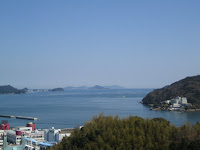


そして神社(じんじゃ)がたくさんあった。

鳥羽に水族館(すいぞくかん:Aquarium)がある。おもしろいどうぶつがたくさんあった。みんなさん、これをみたことがある?


伊勢の神社の中で伊勢神宮(いせじんぐう)が一番ようめいだ。伊勢神宮は二つのところだ。とても大きかった!


Subscribe to:
Posts (Atom)